Let’s begin at the basics:
IGP (formerly known as IPO/Schutzhund) is a demanding tri-discipline sport encompassing tracking, obedience, and protection. Initially designed as a breed test for the German Shepherd, it has evolved into a widely popular sport while still serving as a critical breed evaluation tool for many esteemed German Shepherd breeders. Originating in Germany, Schutzhund has become an international phenomenon, with countries around the world hosting national competitions each year. The top five competitors from each nation advance to represent their country at the world competition (WUSV) held annually in October.
History and Purpose: Schutzhund was developed as the primary method to produce elite German Shepherd Dogs. Max von Stephanitz, the founder of the German Shepherd breed, believed these rigorous tests were essential for breeding dogs with superior working abilities and eliminating those that couldn’t meet the standards. Although designed for German Shepherds, the sport also sees other breeds like the Malinois excelling and having their own world championships.
Training and Bonding: With proper training, IGP/Schutzhund allows handlers to understand how their dogs react under stress, helping the dogs learn to control their drives and obey in various situations. This comprehensive training results in exceptionally well-behaved dogs and fosters a close, responsive bond between dog and handler.
Choosing the Right Dog: When looking for a IGP/Schutzhund puppy or dog, it is crucial to select one from a reputable breeder who actively participates in training, competing, titling, and showing their dogs in IGP/Schutzhund. Opting for a breeder whose dogs have working titles (SchI-SchIII, IPO1-IPO3, IGP1-IGP3) and show ratings/breed surveys (SG, V, Kkl) significantly increases your chances of success in this rewarding sport.
Traits Found in Schutzhund Dogs
- Stamina and Endurance
- Agility and Power
- Temperament and Nerves: Ability to handle stress well
- Courage
- Intelligence
- Handler Loyalty
- Proper Structure
- Desire to Work
IGP/Schutzhund Titles
- BH: Basic obedience and temperament test (prerequisite for IPO/IGP titles)
- IGP1 (SchI / IPO1): First level
- IGP2 (SchII / IPO2): Second level
- IGP3 (SchIII / IPO3): Top level
- GPr1-3 (SchA / IPOA): Obedience and protection only
- UPr1-3: Separate obedience titles
- FPr1-3: Separate tracking titles
- IFH1,2, IGP FH: Advanced tracking titles
- AD: Endurance test (for Breed Survey)
- Kkl: Breed Survey
What Does Each Phase Look Like?
Tracking
The complexity varies depending on the title being pursued, but tracking tests a dog’s ability to scent and follow a trail without distraction or frustration. It evaluates the dog’s confidence and independence as it must identify articles left on the track by the track layer without the handler’s assistance.
Obedience
This phase tests the dog’s intelligence, desire to work, and ability to follow directions under stress. The dog must perform high-level obedience tasks such as heeling around people, responding to commands amidst distractions (like gunshots), retrieving over obstacles, and executing position-related tasks (stand, sit, down). The dog should demonstrate enthusiasm and interest in its work.
Protection
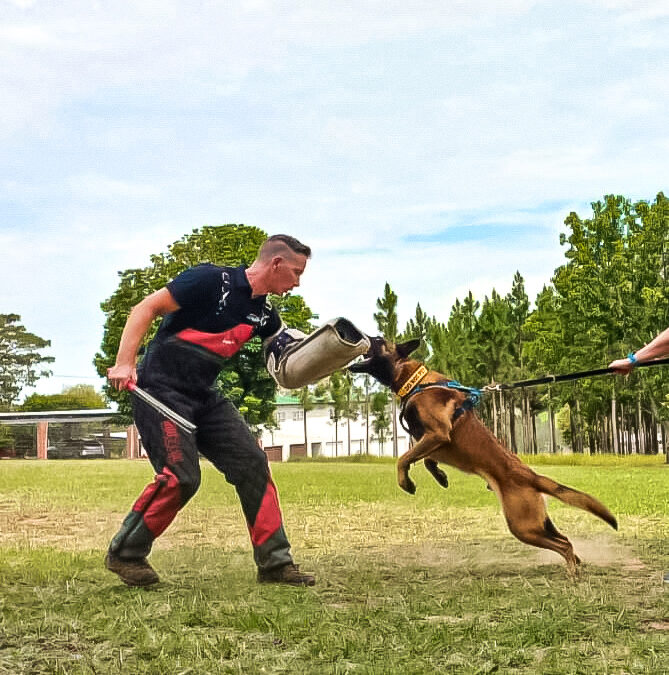
Often misunderstood, this phase involves a ‘helper’ who assists in the protection training. During a trial, the dog must locate the hidden helper and hold him there until the handler arrives. If the helper attempts to escape or threatens the dog or handler, the dog must apprehend the helper by biting the bite sleeve and release upon command. This requires the dog to be both confident and mentally strong while remaining sensitive to handler commands.
Points and Titles
Each title encompasses progressively harder levels of work. For each title, a total of 300 points is available (100 points per phase in tracking, obedience, and protection). To earn a title, a dog must score at least 70 points in each phase during a trial.
The Challenge of IGP/Schutzhund
Schutzhund is uniquely challenging because it combines three distinct disciplines into one sport. Training, titling, and competing require mastering the separate sports of tracking, obedience, and protection, making it a demanding yet rewarding endeavor.